
As electricity costs continue to rise and sustainability becomes a priority, institutions like schools, hospitals, and warehouses are rapidly shifting toward solar energy. Solar power is no longer just an eco-friendly option—it’s a strategic financial decision that delivers long-term savings, energy independence, and operational stability.
Let’s break down how solar power specifically benefits these sectors.
Why Solar Power Makes Sense for Large Facilities
Schools, hospitals, and warehouses share one common trait: high and consistent energy consumption. From lighting and HVAC systems to equipment and IT infrastructure, electricity demand is significant.
Solar power helps:
- Reduce electricity bills by up to 70–90%
- Provide protection against rising energy tariffs
- Ensure uninterrupted operations (especially with battery backup)
- Improve brand image with sustainability
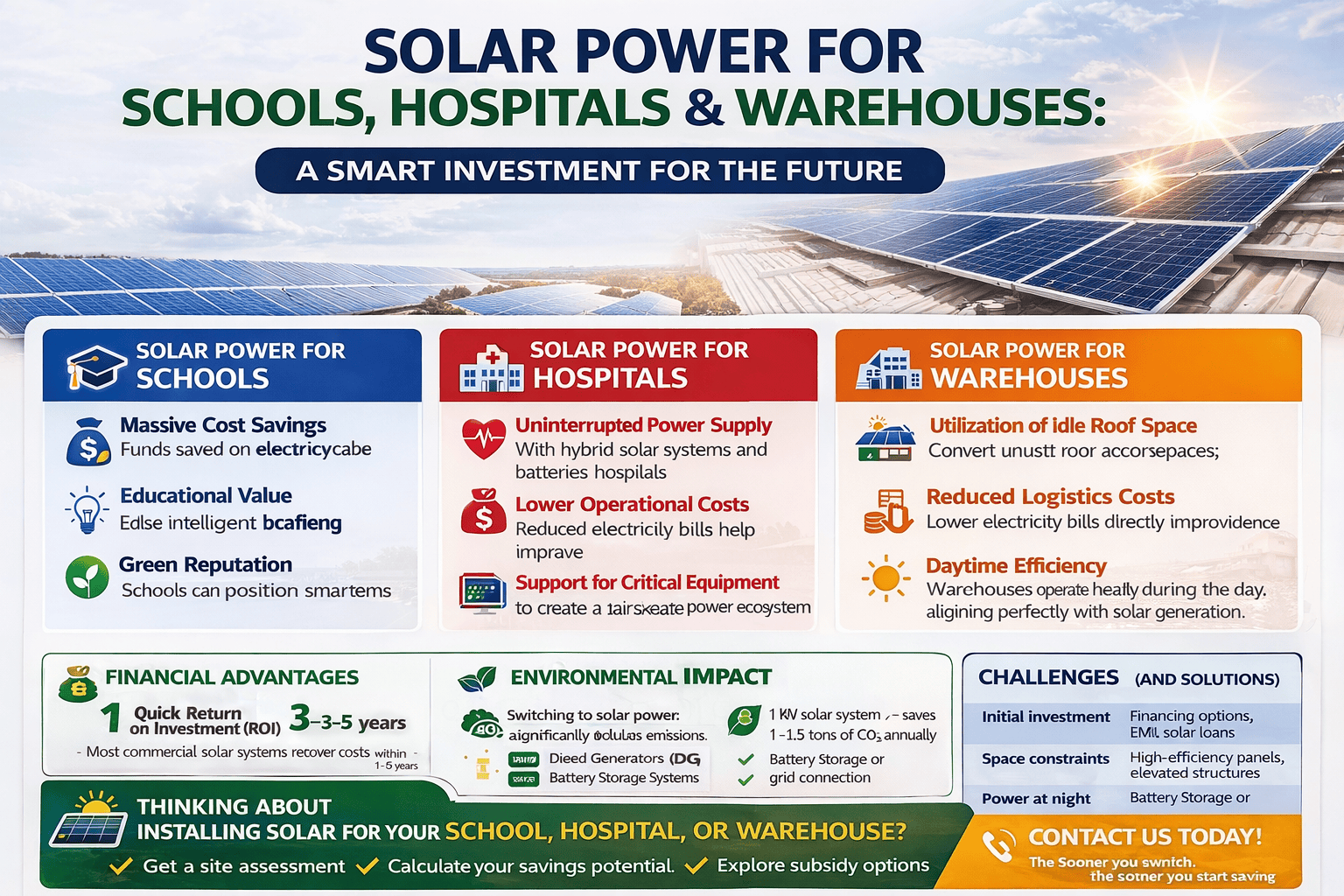
Solar Power for Schools 🎓
Educational institutions operate primarily during daylight hours—making them perfect candidates for solar energy.
Key Benefits:
- Massive Cost Savings: Funds saved on electricity can be redirected toward infrastructure, technology, and student development.
- Educational Value: Solar installations can be used as real-life learning tools for students.
- Green Reputation: Schools can position themselves as environmentally responsible institutions.
Example Use Cases:
- Running classrooms, labs, and computer systems
- Powering smart boards and digital learning tools
- Lighting playgrounds and campuses
Solar Power for Hospitals 🏥
Hospitals require 24/7 reliable power, making energy security critical.
Key Benefits:
- Uninterrupted Power Supply: With hybrid solar systems and batteries, hospitals can avoid power disruptions.
- Lower Operational Costs: Reduced electricity bills help improve overall financial efficiency.
- Support for Critical Equipment: Ensures consistent operation of ICU units, ventilators, and diagnostic machines.
Important Note:
Solar systems can be integrated with:
- Diesel generators (DG)
- Battery storage systemsto create a fail-safe power ecosystem
Solar Power for Warehouses 🏭
Warehouses often have large rooftop spaces, making them ideal for high-capacity solar installations.
Key Benefits:
- Utilization of Idle Roof Space: Convert unused roof area into a revenue-generating asset.
- Reduced Logistics Costs: Lower electricity bills directly improve profit margins.
- Daytime Efficiency: Warehouses operate heavily during the day, aligning perfectly with solar generation.
Ideal for:
- Cold storage units
- Inventory management systems
- Lighting and automation
Financial Advantages 💰
1. Quick Return on Investment (ROI)
Most commercial solar systems recover costs within 3–5 years.
2. Government Subsidies & Tax Benefits
Businesses and institutions can benefit from:
- Accelerated depreciation
- State and central government incentives
3. Long-Term Savings
Solar panels last 25+ years, providing decades of free electricity after ROI.
Environmental Impact 🌱
Switching to solar power significantly reduces carbon emissions.
- 1 kW solar system ≈ saves 1–1.5 tons of CO₂ annually
- Helps organizations meet ESG (Environmental, Social, Governance) goals
Challenges (and Solutions)
| Challenge | Solution |
|---|---|
| Initial investment | Financing options, EMI, solar loans |
| Space constraints | High-efficiency panels, elevated structures |
| Power at night | Battery storage or grid connection |
Final Thoughts
Solar power is not just an energy solution—it’s a business strategy.
If your institution has a rooftop, you already have an opportunity waiting to be unlocked.