
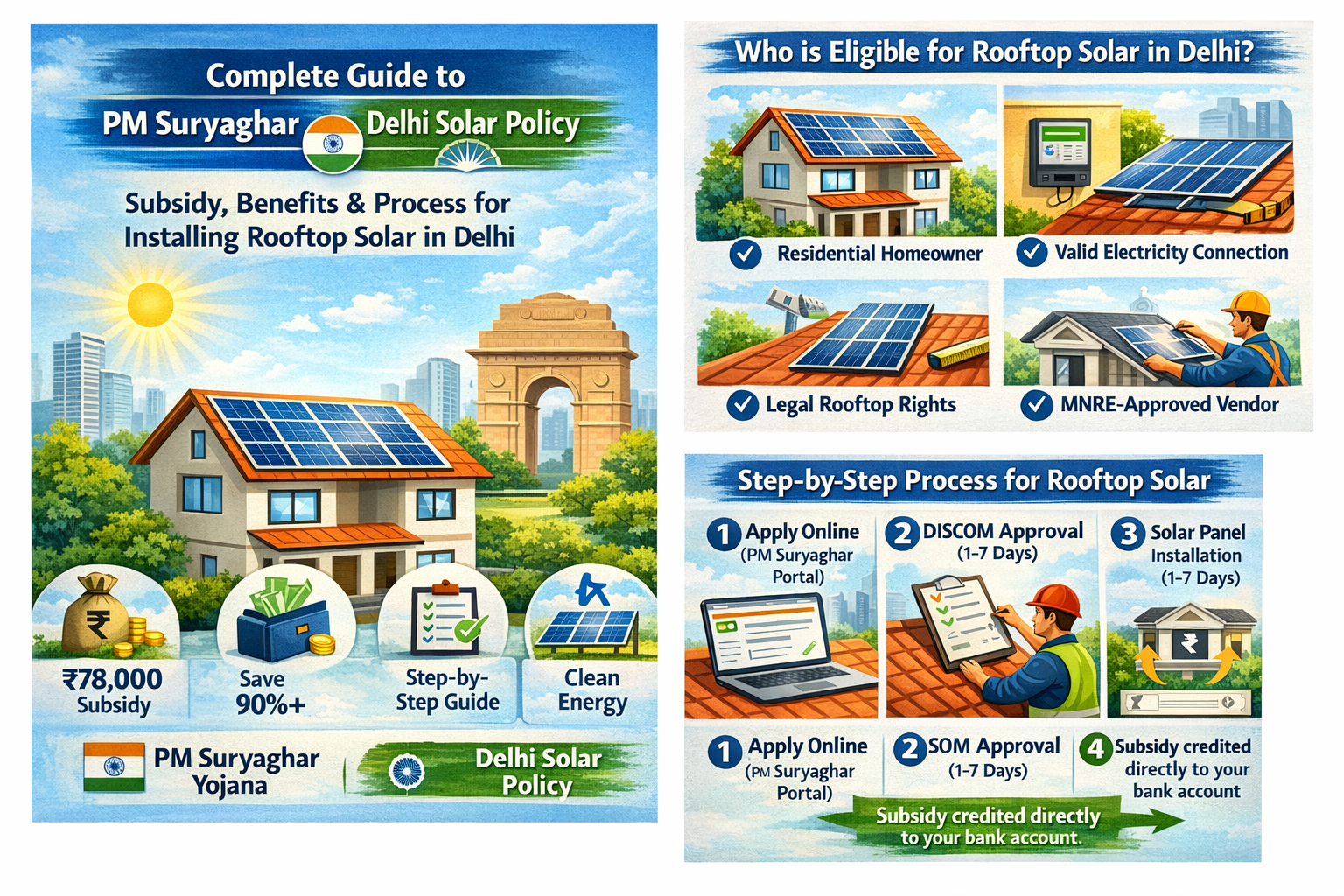
Everything Delhi homeowners need to know about subsidies, benefits, eligibility, and the rooftop solar process
With rising electricity bills and growing environmental concerns, rooftop solar has become one of the smartest investments for homeowners in Delhi. To accelerate adoption, the Government of India and the Delhi Government have introduced powerful subsidy-backed policies that significantly reduce the cost of installing solar systems.
This blog explains the PM Suryaghar Muft Bijli Yojana and the Delhi Solar Policy, how both work together, who is eligible, how much subsidy you can get, and what the complete process looks like for Delhi residents.
☀️What Is PM Suryaghar Muft Bijli Yojana?
The PM Suryaghar Muft Bijli Yojana is a central government initiative launched to promote rooftop solar adoption across India, especially for residential consumers.
Key objective:
Enable households to generate their own electricity, reduce power bills, and receive direct financial subsidy support.
Under this scheme:
Homeowners install rooftop solar systems
Electricity bills are reduced by up to 90%
Subsidy is transferred directly to the consumer’s bank account
This scheme is implemented through the MNRE (Ministry of New & Renewable Energy) in coordination with local DISCOMs.
💰 Central Government Subsidy Under PM Suryaghar (2025)
For residential consumers, the central subsidy structure is:
| Solar System Capacity | Central Subsidy |
|---|---|
| Up to 2 kW | ₹30,000 per kW |
| 3 kW | ₹78,000 (fixed) |
| Above 3 kW | No additional central subsidy |
👉 Maximum central subsidy available: ₹78,000 per household
This subsidy is credited to the consumer’s bank account 45–90 days after system commissioning.
🏛️ What Is Delhi Solar Policy?
The Delhi Solar Policy is a state-level policy designed to further promote rooftop solar adoption within the National Capital Territory.
It works in addition to the central PM Suryaghar scheme.
Objectives of Delhi Solar Policy:
Increase rooftop solar capacity in Delhi
Reduce grid dependency
Support clean energy transition
Provide state-level incentives and facilitation
Delhi’s policy focuses heavily on:
Net metering support
Faster approvals
Additional financial benefits (as applicable under policy updates)
🔌 Net Metering: The Backbone of Solar Savings in Delhi
Net metering allows your rooftop solar system to export excess electricity to the grid.
How it works:
Solar power used directly reduces your bill
Extra units exported are credited
At night, grid power is adjusted against credits
Net metering is mandatory for:
Subsidy eligibility
Maximum bill reduction
All Delhi DISCOMs (TPDDL, BRPL, BYPL) support net metering for residential consumers.
🏠Who Is Eligible for PM Suryaghar + Delhi Solar Policy?
You are eligible if:
You are a residential electricity consumer
You own the rooftop or have legal rooftop rights
You have a valid electricity connection
You install an on-grid rooftop solar system
You choose an approved solar vendor
You apply through the official government portal
⚠️ Commercial, industrial, and society common-area systems are not eligible for residential subsidy.
⚙️ Approved System Types Under the Scheme
Only the following systems qualify for subsidy:
✔️ On-grid solar systems
✔️ MNRE-approved solar panels
✔️ Approved inverters
✔️ Net-meter enabled systems
❌ Off-grid systems
❌ Battery-only systems
❌ Unapproved vendors
⏳ Complete Process for Delhi Residents (Step-by-Step)
Step 1: Online Application
Apply on the PM Suryaghar portal
Choose your DISCOM and vendor
Step 2: Stage-1 Approval (1–7 days)
Government verifies rooftop and load details
Step 3: Installation
Vendor installs the solar system (1–7 days)
Step 4: Stage-2 & Stage-3 Approval
Technical approval + commissioning request
Step 5: DISCOM Inspection
Physical verification of plant and wiring
Step 6: Net Meter Installation
Bi-directional meter installed
Step 7: Subsidy Release (45–90 days)
Subsidy credited directly to your bank account
💡 How Much Can You Save in Delhi?
A typical Delhi household savings:
| System Size | Annual Savings |
|---|---|
| 3 kW | ₹24,000–₹36,000 |
| 5 kW | ₹40,000–₹54,000 |
| 10 kW | ₹80,000–₹1,20,000 |
Over 25 years, savings can reach ₹10–25 lakhs, depending on system size and tariff escalation.
📉 Why Many Applications Get Delayed or Rejected
Common mistakes include:
Choosing non-approved vendors
Incorrect documentation
Improper system design
Missing net metering compliance
Poor installation quality
Choosing an experienced EPC partner ensures smooth approval and faster subsidy release.
🌟 Why PM Suryaghar + Delhi Solar Policy Is a Big Opportunity
For Delhi residents, this is the best time ever to install rooftop solar because:
✔️ High central subsidy
✔️ Delhi-specific support
✔️ Rising electricity tariffs
✔️ Strong sunlight availability
✔️ Short payback period (3–4 years)
✔️ 25+ years of free electricity
✅ Final Takeaway
The combination of PM Suryaghar Muft Bijli Yojana and the Delhi Solar Policy makes rooftop solar extremely affordable and beneficial for homeowners.
If you follow the correct process, choose an approved vendor, and ensure proper installation, you can:
Reduce electricity bills up to 90%
Receive government subsidy
Increase property value
Contribute to a cleaner Delhi
Rooftop solar is no longer a future concept —
it’s a present-day opportunity for Delhi residents.
Want to Install Solar at Your Home? Let’s Talk!
Our team at SOLAR-MAIT can help you with: Site visit, System design, Subsidy application, Installation, After-sales support
📞 Call: +91-844-844-6252
📩 Book Your Free Consultation Today